


Petroleum Ether
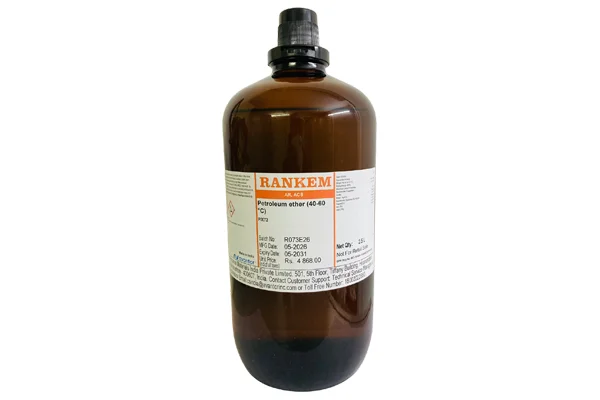
Petroleum Ether
Petroleum ether is a common, highly flammable laboratory solvent. Despite its name, it is not chemically related to diethyl ether ("ether") but is a complex mixture of light hydrocarbons derived from petroleum .
1. Key Properties
-
Composition: A mixture of predominantly aliphatic and alicyclic hydrocarbons, primarily in the C5 to C10 range . Typical composition: 50–80% paraffins, 20–40% monocycloparaffins, and 2–10% aromatics .
-
Appearance: Colorless liquid with a characteristic petroleum-like or natural gas odor .
-
Solubility: Miscible with many organic solvents; insoluble in water .
-
Boiling Point: Varies significantly by grade; common ranges include 30-60 °C, 40-60 °C, and 80-110 °C .
-
Flash Point: Extremely flammable; flash points are typically well below 0 °C (e.g., −31 °C, < -30 °C) .
2. Primary Uses in the Lab
-
Non-polar Solvent: Used to dissolve and extract non-polar compounds .
-
Extraction: Commonly employed for extracting oils, fats, waxes, and natural products like carotenoids from plant or biological samples .
-
Chromatography: Used as a mobile phase or solvent for purification of non-polar compounds in techniques like column chromatography .
-
Chemical Synthesis: Serves as a reaction medium for various organic synthesis procedures .
3. Major Hazards
Petroleum ether poses significant health and safety risks. It is classified as a Danger substance under GHS .
-
Health Hazards:
-
Aspiration Hazard: May be fatal if swallowed and enters airways . This is the most critical acute risk.
-
Central Nervous System (CNS) Effects: Vapors can cause drowsiness, dizziness, and narcotic effects . Chronic exposure may lead to nervous system damage .
-
Skin/Eye Irritation: Causes irritation upon contact .
-
-
Physical Hazards:
-
Extremely Flammable: Highly flammable liquid and vapor. Keep away from heat, sparks, and open flames. Use only non-sparking tools and take precautions against static discharge .
-
Explosion Risk: Vapors can form explosive mixtures with air .
-
4. Handling, Storage, and Disposal
-
Storage: Store in a cool, well-ventilated area in a dedicated flammables cabinet. Keep the container tightly sealed .
-
Handling: Use only with adequate ventilation (e.g., in a fume hood) . Wear appropriate personal protective equipment (PPE), including chemical-resistant gloves and safety goggles .
-
Disposal: Must be disposed of as hazardous waste according to all local, regional, and national regulations .
- In stock: Yes


